Wednesday, 13 June 2012

THIS IS A LIST #6

I cut most of my hair off and spent the weekend in the city of Porto at Primavera Sound, where I waited in a queue in the pouring rain for two and a half hours to get tickets to see Jeff Mangum at the Casa da Musica. 'Worth it' doesn't even come close to a good description because me and my sister ended up sitting a few feet away from him, cross-legged on the floor after he asked the crowd to move closer. Arguably in our rightful place. It was surreal and perfect. I got sunburnt on my arms, shoulder, and mouth (?!?!?!?!?!) and now I'm enjoying peeling away the dead skin way too much. They eat well in Porto, and they put cheese on everything, and the wine is sweet and strong. I loved the beach, too, especially the contradiction of it - pure white sand and sea surrounded by factories and industrial estates.

What else? I turned 23 on the 3rd of June and that was also surreal. It's not that I think 23 is old, just that in my head I still feel as though I'm 16. I mean, I spend every night sleeping in the bedroom of the house I grew up in. I drink in the same bars and spend time with the same friends and I feel like I'm stuck in some kind of weird time warp that is not entirely unpleasant.
Anyway, I spent most of my birthday drunk, except for when I visited the Wellcome exhibition with my friends and walked around the museum for hours and spent £65 on books, as a present to myself. The exhibition was to do with mapping the mind, and in one corner of the museum the curators had set up a video playing footage of two surgeons slicing and preparing brains. It was kind of hypnotic, I think I could have watched it all day. If you think you can stomach it, here is the video:


The brain thing is sort of macabre and I'm gonna follow that theme and say that I've also spent most of my internet time lately obsessively reading through the Websleuths forums for missing people. The cases featured are often sad, and strange, and endless - after reading through many of the threads, I eventually came to automatically expect loose ends and lost girls and clues that trail off into nowhere as the only eventual results. Reading through the forum is frustrating, and hopeful, and terribly sad, and monumentally important.

I've also been reading a lot of true crime and a lot of David Foster Wallace, and I've fallen back in love with Freaks and Geeks big time, especially the character of Mr Rosso. Like, if I was Lindsay Weir, I would have a big fat inappropriate crush on him.


I mean, what a total babe.

Tuesday, 10 April 2012

THIS IS A LIST #5

Guys, here is a shitty reason explaining why I haven't updated this blog in a while: on Valentine's Day this year, I had a date with a bottle of beer, The Simpsons, and some pizza (courtesy of my little brother, of course). It was supposed to be magical, and it was - up until the part where I decided it would be an awesome idea to balance my pizza slice and pot of garlic dip on the arm of the couch so that I could rest my laptop on my knees, therefore allowing me to do some googling and pizza-ing at the same time. I am also the clumsiest person in the world (this is probably shamefully close to not being hyperbole) and hadn't even really lifted the pizza from it's couch-arm base before the garlic sauce kind of tipped over and exploded all over the keyboard of my laptop. It was such a Peep Show moment: disgustingly predictable. Anyway, now most of the keys don't work unless I mash my hand down on them and do a little prayer, and the 'N' key is gone for good. I found this weird touch-screen keyboard on my desktop that I would like to think is some kind of emergency keyboard made for moments like these, but I've decided to go the old-fashioned route - mashing and copying 'n' pasting the letter 'N' from other websites. So far I'm still managing to spend most of my free time internetting, so I'd like to think that in this particular battle of (wo)man vs food, woman has won. I'm trying to write an entry about Neutral Milk Hotel and how they changed my life a few weeks ago at All Tomorrow's Parties, but I'm starting to get this weird claw from copying and pasting too much, so this is my stupid break. Seriously, I was so close to becoming this:


Anyway, today I went to work wearing the shirt I slept in because staying up until 4 a.m. watching Six Feet Under is probably a really bad idea if you have to wake up for work at 6 a.m. and don't want to resemble a zombie. Speaking of Six Feet Under, guys I am so completely obsessed with it - I mean, the main themes are death and dysfunction and fucked up surburbia, how could I not be? And I am also in love with Claire Fisher and kind of want to be her best friend and we can hang out and get high and talk about how stupid boys in high school are and also, Claire, maybe you could introduce me to your brother because it is almost weird how much I relate to Nate Fisher and I'm kind of in love with him and his weird way of talking and I know that I will die when he dies in season five, etc.
this is how I feel about everyone in the world ever, Claire

I see so much of my family, and my friends' families, in the Fishers. The whole aspect of repression and resentment and not having that perfect, harmonious, Walton-esque relationship that is so often televised is strangely comforting. What's also strangely comforting is how Six Feet Under manages to perfectly express the conflict and turmoil of being part of a family and feeling the pull of your own life taking you in one direction, and your loyalty and concept of 'family' desperately trying to cling on and pull you in another. I can see how loyalty would win, and that's what terrifies me - because the family you are from and the heritage and history you have and the class you were born in and the first street you lived down and the house you grew up in and the council estates you roamed around are all such a fucking huge part of you, of who you are. And to denounce your family, to move away from them and make your life your own, is somehow transformed by guilt into being less of a personal choice and more of a denouncement of your history, your class, your background. It seems to me that we just can't seperate the two, or figure out how to hold onto the past without letting it control and potentially ruin us. How many people end up living lives they never really wanted, because of this? That's something that's unbearable to me, and this might sound stupid but I think that's why I've always wanted to leave this town - because if I don't, it won't ever really be my life. I think I'm kinda talking in riddles now, who knows. Writing a blog entry when you're sleep deprived and pill-less is probably not an awesome idea.

Ruth Fisher manages to beautifully express how I feel 99.999999999999% of the time

When I think about this, though, it doesn't begin and end with family - it also makes me think about other things, like how my concept of my own unhappiness is so tied up in the fact that I'm back here, that I've been back here for almost two years now, that (to quote Morrissey, when the things he said were more poetic and less...troll-ish) this town has literally dragged me down. Is it really fair to blame your state of mind on something as simple and obvious as a place? I was unhappy in London, too. I guess the reason I blame Northampton as being the root - if not always the cause - of my unhappiness is because the alternative sort of terrifies me. I could move to Prague, to Montreal, to Berlin, to Amsterdam, to the other side of the world, and nothing could change. You can't run away from yourself. What if I finally get out of Northampton and find that the problem isn't where I am, but who I am? 
Also, like the best dude I know pointed out when we were hungover and giving our friend a tour of the Northampton bus station this weekend, we say we hate this town but we're also kind of obsessed with it. We talk about it all of the time, and most of all, we keep coming back. I guess everyone suffers from this weird kind of masochism - not being able to let go of the thing that you think is ruining you, because in a weird way, it's a huge part of you. Kind of like Chief Brody and Jaws, which probably isn't the greatest example, but I watched Jaws 2 the other day. Once again - how disgustingly predictable.

Saturday, 24 March 2012

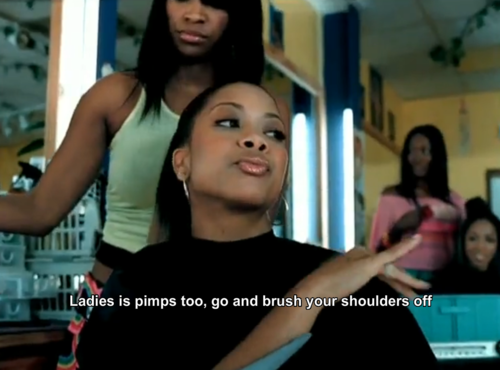
LADIES IS PIMPS TOO - MISOGYNY AND HIP HOP

(originally posted on Retrograde magazine's website)


I remember the first time I listened to Biggie Smalls. I was on the verge of becoming that thing that every teenager dreads and is secretly excited by at the same time – twenty years of age. I was finishing up my second year of university, and I was broke and angry and disillusioned by life outside of my tiny, working class hometown. I felt like everyone had more money than me, came from richer families than me, had received better educations than me, and therefore I spent the majority of the year (and my life at university, actually) precariously balancing between feeling terribly inferior and alone, and extremely bitter. Then I heard ‘Juicy’ for the first time.

At first it seems as though it was a chance meeting, this collision of my late-teenaged self and 90’s hip-hop, but looking back at the grand old age of 22, it’s clear that we were always meant to be. Hip-hop artists in the early 90’s wrote powerful, angry songs about fighting the power and growing up poor and not accepting the place society wants you to have in the world. I can’t relate to being black, or growing up black, and to suggest that anything in my life would ever come close to it would be ridiculous and insulting. However, hip-hop artists rapped about money and class and the role of the poor in society in a way that no white artists I’m aware of have ever really come close to, at least not to me. The working class need a voice, and 90’s hip-hop gave us it.

It’s a well-know theory that the age of fourteen is when we first start breaking away from what our parents and siblings and friends like and start forming our own interests and opinions about society and the different types of culture it offers us, especially in regards to music (I’d like to thank Dr Spencer Reid of Criminal Minds fame for educating me on this). Therefore, the music we listen to at this age influences us in a way that nothing else quite ever will, and not just in regards to something simple as our taste. It’s the first thrill of doing something for yourself, of making a deliberate step towards becoming a certain type of person, of becoming someone who is complex and flawed and human. When I was fourteen, I dyed my hair pink, badly. I read a lot of Chuck Palahniuk books. I kept a livejournal and wrote bad prose and wore a lot of black (some things never change). These things have all greatly influenced the person I have become and am still becoming, in the way that the friends you have at that age influence you in a way that no one else ever really will. It’s not because everything back then was realer, or purer, in the way that nostalgia can sometimes make us believe – it’s not because your friends were any better, or because music was any better, or because society is falling apart and culture is going downhill and everything just sucks now. It’s because it was happening for the first time.

When I was fourteen, I didn’t listen to hip-hop. I listened to The Smiths and let Morrissey guide me through teenage life in a humdrum town, where the days seemed endless. I listened to Bright Eyes and related to Conor Oberst’s angst about youth and growing up and the future in a way that almost scared me – my life plan for a while was to move to Omaha and work at Saddle Creek. I listened to the Manic Street Preachers and became angry and disillusioned with politics and England and money, as well as wearing a lot of eyeliner and leopard print. These bands were my soundtrack during my most formative years, and at the time they defined me and my beliefs and led me through the jungle of adolescence in a way that my family and my teachers and all of those teen-orientated websites and books and pamphlets couldn’t. They taught me about the real world and how to navigate it.

There is something about this list that needs to be recognised, though. The musicians who guided me through perhaps one of the most important times of my life all have one thing in common – they’re white males. I am a white female. Although I am not privileged in some ways, I am privileged in the fact that I grew up with internet access and books and the ability to listen to and appreciate music. So with all of these privileges at my disposal, why did I end up allowing myself to be guided by the one group that has all of the privileges I do not have? The one group that society is under the power of and at the same time caters to?
It’s easy to place the blame on oneself, but I think the root of the problem lies deeper than this. The majority of music young people are exposed to is more often than not written, performed, and controlled by white males. Although, according to our theory, we make our own musical choices at the age of fourteen, we are still young and susceptible to outside influences. We may feel as though we are completely in control of what we choose to listen to, but the reality is that this choice is still made within the context of the society we belong to – and this is a society in which white men rule the roost, so to speak.

Therefore, when considering the context in which modern music is presented, it is important to recognise how misogyny is generated and perpetuated due to it. Obviously, the fact that society is fundamentally a man’s world is in itself a sign of the misogyny that women face every day, and this is represented in the music we listen to. However, perhaps the most interesting aspect of misogyny in music is how reluctant we are to attribute it to white men.

As I stated earlier in this article, I have a lot of love and respect for 90’s hip-hop. I also consider myself a strong feminist. The one question I always hear when I inform people of the above two facts is, without fail, “How can you be a feminist when you listen to music that is as misogynistic as hip-hop?” I have a lot of problems with this response, and what it tells us about the society we live in. I’m not going to deny for one second that some hip-hop is misogynistic – to do so is counter-productive, because it is very true that some hip-hop music does focus on belittling women and therefore reinforces the idea of men as being superior. The point isn’t that hip-hop music is not misogynistic – the point is that it is no more misogynistic than other genres of music, but is constantly scapgoated and focused on as being the only music that is misogynistic and therefore dangerous towards women. I believe that misogyny is just as rife in other genres of music, but because this music is created by white men in a society that favours white men, it is not picked up on. It is a lot easier to blame the minority instead, because it is not the minority who controls the context in which we listen to music. It is easy to blame a black man for misogyny towards women being perpetuated through music, because it is simpler than going against what society tells us.

So what is the logic for hip-hop being universally referred to, and thought of, as misogynistic? Firstly, one of the main points that is brought up is the language which is used towards women in many hip-hop songs – “they’re always calling women bitches! Or hoes!” should really have been copywrited by now, I hear it so often. The fact is that, yes, a lot of hip-hop songs do use language that is potentially derogatory when referring to women. However, it is important to also consider the cultural context in which the word is being used, and who it is being used by. Many female rappers have reclaimed words such as “bitch” and therefore refer to themselves using the word, and will also sometimes accept being called it by men in songs, as long as it is on the terms they have laid out. Obviously not all uses of potentially derogatory words in hip-hop are by women and not all of them are intended to be complimentary. However, although no man has the right to refer to a woman as a bitch or a whore or a hoe (which in itself is a gross stereotype of most hip-hop music), and no woman should be subjected to it against her wishes, the sometimes-explicit use of the words in hip-hop songs makes it a lot easier for us to identify what is and is not misogynistic. This might sound like a strange thing to include in an article that wishes to convince you that hip-hop is no more misogynistic than any other genre of music, but it is important to consider when discussing why the majority of white, male music is not seen as being misogynistic.

So, hip-hop is widely considered to be misogynistic because of the language many artists use to describe women, including women themselves. What could be more misogynistic than a woman being referred to as a bitch or a hoe? Well, at least if a woman is described using a word that is widely thought of as sexist and derogatory, it is easy for us and most of the general public to recognise it as being offensive and not accept it. However, not all misogyny is presented through a nasty word or name-calling, and this is the biggest issue I have with hip-hop being referred to as more misogynistic than other genres. I believe that other genres of music, mostly represented by white men, are so full of misogyny that is internalised and accepted in society, and this is dangerous because it means that we are not always aware of it.

So if misogyny in hip-hop is mostly presented through the language used, then how is it presented in other genres? Internalised misogyny is not as simple as a woman being referred to in a negative way – instead it reinforces ideas about how women should act, specifically in regards to men, in a way that is subtle and not always recognisable as being negative. The popular-in-2006-on-myspace genre of music known as ‘emo’, or emotional hardcore, is especially responsible for encouraging this way of thinking. I love Brand New, but think of ‘Jude Law and a Semester Abroad’ (sample lyric: “and even if her plane crashes tonight/she’ll find some way to disappoint me/by not burning in the wreckage/or drowning at the bottom of the sea”). Jawbreaker are an amazing band and most of Blake Schwarzenbach’s lyrics are perfect to me, but think of ‘Sluttering’. Dashboard Confessional were the first band I listened to on my walkman in 2004, but think of everything Chris Carrabba has ever written. What do these artists all have in common? They are intelligent, middle class, white males who comment sharply and succinctly on social issues and politics and heartbreak and adolescence (Chris Carrabba only gets credit for the last two, though).However, they also rely on the idea of women as being one-dimensional and almost fictional in their attributes and identities. Take Brand New first, for example. In ‘Jude Law and a Semester Abroad’, Jesse Lacey focuses on how the girl mentioned has wronged him, how if a plane crash didn’t bring her imminent death then it would be purely to disappoint him. Basically, the female character exists only as a catalyst for his anger and heartbreak, not as a real person. The same can be seen in ‘Sluttering’ and perhaps most explicitly in many Dashboard Confessional songs. Females are either described as being weak and simpering, purely as a love interest for the protagonist, or as cold-hearted and evil, the source of his pain and frustration. The problem with these representations of women is that they are just not realistic. A woman does not exist purely to appease a man or to justify his anger or hurt. Women are not either one thing or another – we are more than the stereotypes we are presented as in modern music.

Another issue that arises when discussing misogyny in hip-hop is, inevitably (and rightly so), regarding race. Is it any coincidence that hip-hop music is mostly written and performed by black men? It is easier for a society in which white men hold the most power to accept that it is not ‘one of us’ perpetuating these ideas. It is easier for white people to accept the idea of a black man encouraging violence and oppression against their sisters and daughters than it is to accept that it might be a lot closer to home than that. A lot of this is to do with extremely racist connotations and stereotypes, the idea that black hip-hop artists are all gangbangers and live in ghettos, promoting the kind of lifestyles that respectable white men would never lead. Sadly, it’s easy for society to justify this extremely racist train of thought, as it is a result of a misguided attempt to fight oppression. It’s easier to accept it than it is to challenge it, and this is where we are going wrong.

This is not a denial that misogyny exists in hip-hop. This is not an excuse for the vile language that is used to shame and oppress women by some hip-hop artists. This is not a condemnation of every song written by a white man. This is a wake up call to everyone who believes the stereotype that misogyny is only perpetuated and generated by black men, that calling a woman a bitch or a hoe is the only way in which she can be dismissed or oppressed, that our opinions and choices are made fairly and freely and are not influenced by a society that is white and inherently misogynistic. This is, to paraphrase Biggie Smalls, to all the ladies in the place with style and grace who refuse to accept what society tells us we should accept, and who refuse to accept misogyny only when it is well-hidden and sung to us instead of rapped.

E-LIFE AFTER DEATH

(originally posted on Retrograde magazine's website)


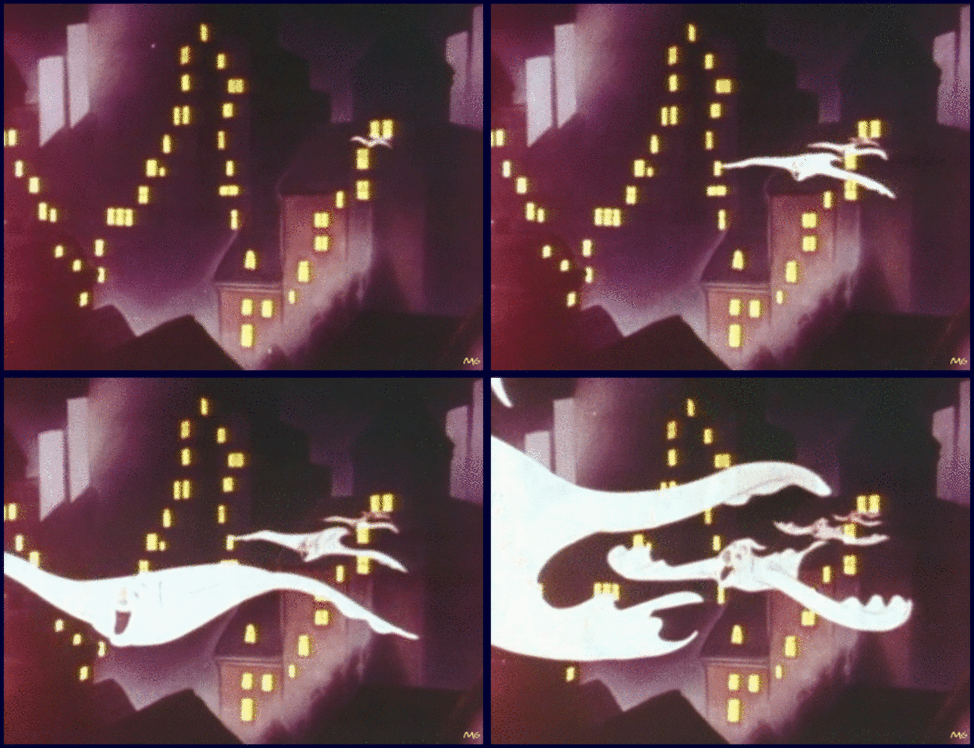
The internet is full of ghosts. From the deepest, darkest, dustiest corners of the World Wide Web to the welcoming home page of your browser, the internet is the ultimate haunting ground if you’re willing to suspend your hard-earned belief that ghosts only exist in horror films. These ghosts aren’t caricatures, like Casper and his merry band of followers. They’re not even really paranormal, in that sense that there are no reports of online poltergeists or heavy demands for browser-exorcisms. This is haunting of a different nature, and the ghosts are of a different nature. Because, after all, what do we really mean when we use the term ‘haunted’? These days, it’s obvious that it has evolved into something less to do with the paranormal and more to do with human nature. We are haunted by death every day but not because we have a direct hotline that links us to ghosts and ghouls and all things terrifying - instead we are haunted in ways that, to those who have not yet become part of the club, seem to be almost imperceptible.
One of the strongest examples of this daily haunting comes in the form of the internet. If you are reading this, if you are browsing the internet right now, then you are probably a member of some kind of social networking site. If you are a member of a social networking site (be it Facebook, Myspace, or even Bebo – but if it is Bebo, then ouch) then you will have friends on that site. If your number of friends on that site equals or betters the number of friends of the average user, then I can guarantee that you are being haunted.

It might take you a while to notice it. You might come across it firstly in the form of a status update about someone’s granddad, someone’s dog, a friend of a friend, which you scroll past too quickly. This kind of ghost is easy to ignore. Then, slowly, it starts inching closer. An acquaintance from school invites you to a memorial group for a mutual friend. Facebook pages dedicated to those who have died in tragic accidents are mentioned in the local newspaper, alongside an obituary. When you google the names of local deaths out of morbid curiousity, you come across blogspot posts, livejournal entries, tumblogs, and tweets before any definitive news articles appear. You’re surrounded by ghosts.

Many people believe that this modernisation of grief is due to the iron grip technology has on the world, and proof that even the starkest human emotions are not immune to it. Borne from this belief is also the opinion that, because they are expressed online in a public setting, these feelings of grief are not completely natural and instead are somewhat doctored and dramatised for their online audience. To assume this is not only incorrect but also dangerous, and I think that to reduce online memorials to this is doing the movement (and I believe it definitely is a movement, for better or worse) a great disservice. I do not believe that online memorials have been created as a means of competition, of showing who is ‘grieving the hardest’. I do not believe that they have become popularised purely due to morbid curiosity, although it definitely is a huge factor. I do not believe that a person creates an online memorial simply because the internet is there and we have all become slaves to the proverbial machine. I do not believe that grief which is shared via a social networking site is any less real or deeply felt than grief which is internalised and hidden away (the ‘stiff upper lip’ school of thought) - in fact, I think that one of the main reasons young people in particular turn to the internet when grieving is that it allows them the chance to take hold of it and manage it in a way that is comfortable and familiar to them. I believe that online memorials are simply a modernisation of the ultimate ghost, the thing that haunts every one of us on a daily basis – our fear of death, and our ultimately futile attempts to control it.


When discussing death and the internet, it is impossible not to mention the behemoth of online memorials, mydeathspace.com. In the same way that many people can recall exactly where they were during Princess Diana’s death, or the falling of the twin towers, I can remember exactly where I was when I discovered mydeathspace. I was eighteen years old, fresh out of state school, in my first year of university. I was living behind a book shop on Gower Street and it was the beginning of a new year. I was sitting at my tiny desk, with the Ethernet cable carefully balanced between the wall and my laptop. I can’t remember what exactly I was doing, but I know I’d been reading about the Columbine shootings when the now-familiar skull banner appeared on my screen. I clicked it and my life changed.
Mydeathspace.com is a website and forum dedicated to chronicling and discussing death. In the archive section, you’ll find a depressingly endless list of people who have died in specific ways. They each have their own page, listing at minimum their name, age, date of birth, and a link to their social networking site (hence the name mydeathspace). If you head over to the forum, you will find thread after thread discussing the saddest and strangest deaths.

My discovery of mydeathspace hit me like a ton of bricks. I’d never been so aware and terrified of my own mortality. The majority of people listed on mydeathspace were my age or younger, and having the links to their social networking sites provided for me meant that I couldn’t ignore them or write them off as another teen tragedy. Mydeathspace offers a level of intimacy that no either grieving process can provide – social networking sites are often no-holds-barred, and comments from friends and family provide another dimension to the deceased that an obituary in a newspaper never will. This is part of the popularity of mydeathspace, and is also where the controversy lies.
It’s no coincidence that mydeathspace has a Hate Mail section, and a brief glance through the forum only confirms that some people are not very happy at all with the existence of such a website. Mixed in with discussions between users and comments hoping that the deceased will rest in peace are angry postings from family members, friends, and locals, defending the deceased and demanding that the website be taken immediately. There are outcries of offense, of not wanting to read ‘that’ about their child/friend/brother/sister written by a stranger on the internet. This is where part of the main controversy lies – in the idea that by modernising death, by archiving pages after pages of dead youth’s facebooks, mydeathspace is somehow trivialising what happened to them. It’s easy to understand the parents’ point of view – some tragic deaths are horribly exploited on the internet, as in the case of Nikki Catsouras. There are websites that sadly do exist in order to trivialise death and jeer at people who have died and their families, but mydeathspace is not one of them. Instead, I believe that this initial shock and disgust at finding a friend or family member resting within mydeathspace’s archive is linked into our basic human fear of death. With websites like mydeathspace, we are confronted with death head on. It’s lined up and packaged neatly in front of us, archived in black and white. It reinforces the everyday brutality of death, contrasted harshly against the fragility of life. It’s hard to bear. Seeing passport sized photographs of people who could have been so much more, row after row after row of them, is hard to bear. But death exists. It is an absolutely certainty in life. What happens when we choose to ignore it, when we choose to x out and close the page? What kind of memorial are we leaving behind then?

The other aspect of controversy that mydeathspace brings is not just the general nature of the website, but the specific content. Most people think that sex is the last taboo, but I disagree. It’s death. In this society, it would be pointless to argue against the fact that some deaths are seen as being more desirable and socially acceptable than others. Natural deaths, for example, are acceptable – they are almost comforting, as they seem to suggest that it was the deceased’s ‘time to go’. They fit in with the ideas we have of the world as being just and right. Noble deaths are also acceptable – if someone dies for their country, or whilst saving a life or helping others, the taboo of death is automatically lifted. It’s okay to talk about these deaths, because they are a representation of how good and kind the deceased was. They emphasise their best qualities, and leave a positive memory for those who knew him or her.
Other deaths, however, remain taboo because they are still not seen as socially acceptable. Deaths from drug use or overdose are often not talked about, as society still seems to have the underlying view that if someone is suffering from a drug problem or takes drugs recreationally then they are bad and wrong and therefore their death is not as much of a tragedy. Their death is unnatural and therefore undesirable, but it is not unexpected. Many of the angry comments posted by family members that I mentioned earlier appear in threads regarding a child who died through illicit drug use or overdose – it’s sad but true that many families still cover up drug-related deaths and therefore do not want this news to be readily available. There is the fear that their child will be dirtied, viewed as less valuable, and that they will be remembered as something undesirable, such as a drug addict. What these family memories (perhaps understandably) don’t realise is that mydeathspace is not passing judgement on the way in which any of these people have died. Instead, it is a place where forum members can discuss the death and try and discover what the deceased was like, via their social networking page. Mydeathspace is trying to get us to talk about death, to inform us that no death should be hidden away and viewed as shameful. Only by discussing death and the deceased can we attempt to face our fear of death.

Suicide is perhaps the most taboo death of all. Although suicide has become more widespread in the news, this does not mean that it has been accepted by society. In fact, suicide is viewed as being perhaps the most undesirable, unacceptable death of all. For most people, it goes directly against their views that life is sacred, and should be lived to the full. Society celebrates life, and it celebrates wanting to live. It sounds hyperbolic, but it is fair to say that everything that exists in our society is an attempt to preserve life, extend life, and give us a better quality of life. This is why suicide cannot be accepted. It is perhaps the saddest, hardest death to come to terms with, not only because mental illness is still so misunderstood. Depression is still seen as shameful and more of a state of mind than an illness – we are taught by society that the acceptable way to respond to depression and mental health issues is to work our way through them and ‘be strong’, which sadly reinforces the idea that depression can be beaten this way by everyone. Once again, mydeathspace does not want us to be shamed into hiding or covering up mental illness, and any death that is a result of it. By offering a forum to discuss suicides, and by linking to the social networking pages of those who have committed suicide, mydeathspace is normalising it and allowing us to see the differences between each suicide, and to understand that anyone can suffer from mental illness. Suicide needs to be more publicised in this way, a way that does not demonise or glamorise it, so that the taboo attached to it is finally removed.

Mydeathspace ultimately exists because humanity has an almost animalistic desire to control what it is scared of. Death is the final end, the giant full stop. What is said about us in death reflects who we are as people just as much as what is said about us during life does. Online memorials do not trivialise us or make us one dimensional – instead, they capture us as we were in a certain moment and they make us human. I still remember the first mydeathspace article I read. It was for a young girl, Californian, who died when she was 15 years old. Her name was Kate Persten and for days I read her myspace, her last blog entry, and comments from her friends and family. I was immersed in her life, and her myspace made me feel like I knew her, if only for a moment. It offered me a glimpse into her life, the kind of person she was, and the way she interacted with people around her. It made the loss all the more extreme.

When we read obituaries, it is often hard for us to fully connect with them and feel the impact of each death personally. Perhaps this is a good thing. Most obituaries focus on how good the deceased was, how loving, how kind. I do not doubt that any of this is true. Mydeathspace, however, focuses on more than just the words of others when offering a memorial – it allows us to briefly enter the deceased’s life, to get to know them for an hour or so. In doing this, we come to view them as more than just a collection of adjectives. We don’t view them by their full stop. We see their flaws, their bad grammar, their posed pictures and the youtube video they posted the night before it happened. We see them as human, as they were in life rather than death. What could be better than this? With a social network memorial, friends are constantly posting memories, family members are tagging baby pictures, and comments from acquaintances fill up the page on public holidays. They don’t wither like flowers at a grave. I don’t want a tombstone for these years, a sentence supposed to define me that ultimately says nothing about me. I’d rather have a Myspace.

Tuesday, 7 February 2012

GIRLS ON FILM

Or: a list of every female character I've related to or wanted to be soul sisters with.


Much has been written about the general demise of society and humanity due to television. According to many articles and textbooks and studies, it is dangerous and soul-sucking and - worst of all - terribly uncultured. If you watch television, you are a couch potato, a mindless drone, a slave to the machine, completely unaware of society and your place in it, happy to be just another cog in the wheel. As well as reinforcing classist ideas and contributing to the school of thought that only that which is educational, and high brow, and ultimately middle class and white, is of cultural significance and worth attaining, this belief that television is destroying our youth and society itself also ignores the main draw of television - how universal it is. T.S. Eliot once said that "Television is a medium of entertainment which permits millions of people to listen to the same joke at the same time, and yet remain lonesome", but to me this isn't what television is for. One of the main arguments against television is that it turns us passive, and does not allow us the opportunity to connect with other people. I think that this line of thinking is a mistake - television does not exist necessarily to bring us together, or to allow us to relate to one another, or to help us to further understand the (quote) human race. Instead, it holds up a mirror to each individual, and we find parts of ourselves in the characters of the shows we watch, parts we accept and parts we attempt to hide from ourselves and others. Television allows us to examine the dark underbelly of our personal identities. To some, this might seem like a disaster - to me, it's a small victory.

This examination of identity is especially important in regards to being underprivileged, or a minority. Television is one of the ways in which we can see how others view us ('us', in this case, being women) and the dangerous ways in which this is presented - it is one of the ways in which we can recognise what is right and what is wrong, and what makes us feel ashamed or othered. It is also a way for us to feel a sense of solidarity or support when we find a character we relate to - because women aren't are a general Thing, and a specific female character isn't something that either all women or no women will relate to. She'll have haters, basically, because all women are different and we're gonna want different things in a television character. And that's fine! And that's why it's so important that television speaks to us individually, that it allows us the opportunity and time to relate to characters on our own terms. Television can be a way for the patriachy to once again reinforce female stereotypes, and use women as pawns or 2D characters that exist only in relation to men - but it is also a wonderful antidote to that. Here is a list of my favourite females from the big bad ol' television (and film), girls that I relate to and make me understand that the best and worst parts of me can coexist peacefully (kinda, anyway - I don't think my love of Law and Order SVU coexists too peacefully with working 9-5 and therefore wanting to be able to sleep at night).

Lindsay Weir, Freaks and Geeks
Oh, Lindsay. You're a secret math geek and all you want is to be accepted by the local stoners and occasionally kiss Daniel Desario on the mouth (and who can blame you, really?). When I first started watching your show, I coveted your army jacket and your perfect center-parting (my forehead is too big and my fringe too curtain-inclined to even attempt it). You have more guts than me, because I never would have even dared to attempt to approach the freaks on the patio at school when I was 17 and a bit years old. I used to walk around with my walkman in my pocket, listening to Blink 182 and being terribly anxious of everything. Our differences aren't that important, though - what I can relate to is your desire for the big wide world, a life outside of surburbia (your suburbs are a lot nicer than mine ever were, though) and school tests and hanging around with the same crowd every night after school, getting drunk and/or high and wishing you were somewhere else. I can relate to being at that awkward stage when you still want to make your parents proud and get residual guilt about not turning your homework in on time, but also want to be grown up and independent and achingly cool. I relate to your teen angst and wanting the one you can't have and your desperate need to have a life that is your own. Also, that one episode where you smoke a lot of weed and think your life is a dog's dream reminds me of this huge marijuana-induced existential crisis I had in amsterdam when I was nineteen. We were meant to be.

Andie Walsh, Pretty In Pink
Andie, Andie, Andie. I relate to you in a lot of ways - firstly, we're both ginger and have a penchant for crocheted things and rolling our eyes a lot. Secondly, your friendship with Ducky reminds me of the friendships I've had and lost, and the friendships I have now - hanging out in dive bars, outcasting ourselves at school, telling our life stories to each others parents. And thirdly, most importantly, you are not rich. You are not middle class, you are not wealthy, and you do not fit any of the stereotypes of the working class that the media likes to present to us (jolly, accepting of your lot, poor in wealth but rich in love, etc). You are poor, and you are angrily poor - you are embarrassed by it and frustrated by it and you're trying to be a kid and experience things like first love and making out and prom and all of the other things that people your age are doing, as well as convincing your dad to get a job and trying to stop the boy you like from driving you home because then he'll see that you're not wealthy like him. It's not embarrassing being lower class, and now that we're older we both know that, but when you're a teenager it seems like it's the only thing that matters. The thing that resonates most with me, that made me realise how alike we are, is the moment when you're looking around the expensive department store for a prom dress, and everything seems to scream to you that you don't belong here. The feelings of inadequacy and frustration that result from your attempt to temporarily escape your class could not ring truer.

Olivia Benson, Law and Order: SVU
Olivia Benson, my queen, the better half of my favourite duo, and a role model for every girl who wants equality. You are on the list mostly because you deserve it, and also because there are two girls who would probably hate me forever for not including you. As a woman, you have had to fight twice as hard to prove your worth and you make sure that because of this, no other woman is neglected or left behind.
My favourite Olivia moment is in the SVU episode '911', when the department receives a call from a young girl who appears to have been abducted but can't say where, exactly, she is located. The male detectives are about to give up on the case and put it down to being an elaborate prank, but Olivia keeps in touch with the girl, eventually finding and resuing her. What makes this episode more important to me is that it focuses on a Spanish girl who was not born in the USA. Olivia's dedication to finding this girl is in sharp contrast to the degree of focus given to missing white and middle class children in the real world - it's a sad fact that missing persons cases involving people of colour do not involve anywhere near as much publicity or media frenzy. The episode highlights this whilst at the same time also highlighting Olivia's dedication to equality for females everywhere.

Enid Coleslaw and Rebecca Doppelmeyer, Ghost World
Enid and Rebecca, Rebecca and Enid. I remember watching Ghost World for the first time when I was around 14, and it was like walking into a movie that was full of my friends. In my head, I was Enid and my sister was Rebecca, not just because they shared the same name but because she was cooler and more grown up than me - more ready to accept things head on, whereas I wanted to hide under the blanket of high school apathy and sarcasm forever.
What I like most about you, Enid and Rebecca, is that although you may have a lot of teenage angst and faux-hatred directed at the world immediately around you, you have love for each other. Ghost World taught me that it is cool to be yourself and roll your eyes at popular people who tell shitty jokes and want to keep in touch after graduation, but also that it is cool to love your friends and to have that one person who totally Gets You and will be your partner in crime. Enid, you hid your insecurities and uncertainty about the world behind cat-eye glasses and punk rock hair and cynical witticisms - I hid mine behind The Smiths and battered converse and going to gigs and an online blog about how much school sucked. What I can relate to most is that, under your cool exterior, you were scared of leaving a world where you were known and recognised, where you were sure of what your place was - high school outcast, hater of suburbia and lover of old jazz. You were scared of the real world and having to forge an identity in it and having to make your mark because without the context of small town life and high school, you weren't really sure who you were. Neither was I.

Betty Rizzo, Grease
This used to be a guilty confession, but now I've accepted it as fact and can pretty much deal with everyone knowing it - when I was growing up, Grease was my life. Between the ages of around 6-10, the majority of my memories are spliced with various scenes from the musical. One of my favourite things to do back then was to dress up in a cardigan courtesy of my grandmother, flip out my hair, and sing Hopelessly Devoted to You, even though I knew back then that Sandy was kind of a drip. My go-to character was Frenchy, because I wanted her pink hair and also for a pop star-slash-angel to descend from the sky and serenade me in a diner someday. However, I was always in awe of Rizzo - I didn't even attempt to mimic her outfits or mannerisms or songs, because I knew no one else could do them justice.
Rizzo is not the kind of girl I am but the kind of girl I want to be, or at least have as a friend. When I was younger, I wanted nothing more than to go to her sleepovers and get wine-drunk and climb out of the bedroom room at midnight to go and meet boys. I wanted someone who would guide the way for this kind of lifestyle for me but he or she never turned up, so I resorted to drinking whiskey alone in my room instead. I wanted to know someone as fearless and loyal as Rizzo, someone who did exactly what she liked and was ahead of her time and was unashamedly pro-sex, pro-alcohol, pro-doing whatever the fuck you want, at a time when women were not supposed to act like that. Amen.


Lisa Simpson, The Simpsons
Lisa Simpson stole my heart when I was around five years old and watching The Simpsons was something I did every weekend with my sister and my grandpa. It's fair to say I grew up with her - The Simpsons premiered the year I was born and 22 years later, I'm still watching it.
Lisa might be a four-fingered, 8 year old, yellow cartoon character but she's also many other things that I can relate to - a feminist, a vegetarian, an avid reader, fiercely dedicated to social issues and fighting injustice, as well as casually name-dropping Gore Vidal in conversation. As well as this, I can also relate to her attempting to find her place in her family of oddballs - she's at that time in her life where you start to realise that maybe your parents don't know everything, and that you potentially share fundamentally different views on certain topics, and it's awkward and sad and strange and you end up trying desperately to hold onto your own beliefs whilst fitting them around the beliefs of your family, kind of like a giant game of Tetris.
There are many articles floating around the internet praising Lisa Simpson for being the only truly feminist tv character - whilst I don't believe she's the only one, she is one of the best examples of one. She might conform to gender norms in that she plays with a malibu stacy doll, but she creates a modern apartment for the doll with a kitchen where she can print her "weekly feminist newspaper", which shows that she is more than aware of the stereotypes placed upon women in society and how dangerous they can be. She also enjoys The Itchy and Scratchy Show, a cartoon that depicts violence which is usually targeted towards a male audience. Despite being a 2D cartoon drawing she is not a 2D character - she often struggles with what she believes about feminism in theory and implementing that into the real (ok, real-cartoon) world, which makes her seem all the more human. Also, in one episode she takes on the malibu stacy company by creating her own talking doll, which includes the catchphrase "When I get married, I'm keeping my own name!". Pretty badass for an 8 year old.

Tuesday, 3 January 2012

THIS IS A LIST #4


Hey dudes! I have been M.I.A for a while due to life kind of getting in the way of the internet (by 'life' I mean drinkin' a lot of gin, catching up with old friends, and plenty of law and order reruns. Also, Christmas!) I have a few posts in the works, but I'm the kind of person who will starting writing about one topic, then either fall asleep/get drunk/start playing bubblegame.org and completely forget about it. Repeat this for a few days, only with different topics, and you'll kinda understand the state that my blogspot dashboard is in...first drafts everywhere. Perhaps this is why I failed so much at being a good university student. That and my ethernet cable and £2 bottles of wine from tesco.

Anyway, in the time that has passed since I last posted here, I celebrated christmas, celebrated the beginning of the new year, bought a skateboard, reunited with my first love (books, and a hell of a lot of em at that), cut off half my hair due to tremendous boredom, and had my first article published by the wonderful Retrograde magazine. Retrograde focuses on issues that are perhaps not as extensively covered as they should be, specialising in feminism and controversial subjects, and I'm proud to be a part of it. Read my article E-life After Death', which focuses on the rise and controversy of social networking memorials, here.

Wednesday, 9 November 2011

WEIRD SCIENCE


So I fell and ripped up my knee a whole lot and now it's kinda gangrenous and oh man there is literally no physical feeling in the world that can beat pulling-your-skintight-black-drainpipes-and-a-few-layers-of-skin-away-from-the-graze-they've become-cemented-to in terms of pain.

(the extraction of a salivary stone)

November has only just begun and already it seems like it's gonna be the month of weird/gross illnesses and afflictions. I had tonsillitis last week and I couldn't stop inspecting my throat. I even took pictures. It was interesting until I got to the third day of not being able to eat or sleep. Those are my only hobbies so life was pretty bleak for a while.
Also, a lady I work with bought in a saliva stone to show us. It looked like an orange pip and it had been growing in her mouth under her tongue for a while, until it all burst open and this orange-pip-lookin' thing came flying out. Unreal. She's keeping it as a memento and I told her that I look forward to seeing what other foreign objects she might have growing inside her. Maybe we can start a museum.

(colon with elephantitis)

Speaking of which, when I travelled to Berlin earlier this year I made a point of visiting the Berliner Medizinhistorisches Museum der Charité. It's a tiny museum hidden away by the river and it's entirely dedicated to medical oddities and illnesses. As you walk up the rickety stairs into the first display room, you are confronted by old medical devices, cut open skulls, wax faces with different types of eye infections and leakages carefully sculpted and labelled. There's the perfectly poised hand of a skeleton behind a glass partition. Another room is almost transformed into a hospital wing, with hospital beds and treatments throughout history set up for various maladies. A lot of them are not unlike torture devices (or at least what a naive 20-something imagines torture devices to look like.)

(selection of brains)

The room that draws the most crowds, however, is at the top of the museum and hidden away behind another exhibition. Part of me thinks that this is done for effect, so that the room is even more impressive when it is eventually reached, and the other part of me thinks that it is borne out of fear. Fear of the response from that great beast The General Public, fear that the museum will be deemed not medical and informative but grim and macabre. Fear of, as I mentioned in an earlier post, the taboo of death in our society.

(tattooed skin)

The top room in the museum is host to a wide range of strange, hideous, sad creatures. When you first walk in you're greeted by rows of display shelves, similar to bookcases. They reach the ceiling. The room is clinical and dark and cold. To someone who has never been in a science lab, it feels exactly like a science lab. It's almost like the museum is appealing to our unconscious desire - the desire to be viewed as scientists, not spectators. The first 'bookshelf' of oddities is mostly feet and hands - feet with elephantitis, feet that have toes missing. Hands with arthritis and crooked fingers. It's disturbing, but it feels almost detached and impersonal. It's difficult to look at those hands floating in jars of preservative and feel any connection or sadness. As you move beyond the row of hands, there are hearts, livers, an elephantised colon that is so huge it has its own table. There are scraps of tattooed skin perfectly preserved in jars - one that caught my eye was a pinup style woman tattooed onto what was once an arm. It's unsettling.

(enlarged skull)

Perhaps most unsettling of all is when you reach the back of the room, past the hearts and the blackened lungs and the solitary penis (I'm a teenager forever, and I laughed when I saw it, okay). There are rows of unborn fetuses, stillborn babies, babies with oversized skulls. there are siamese twins connected forever in the same jar. A baby that choked itself with the umbilical cord, preserved with it still wrapped around its neck. It's miserable and horrifying and bleak. It really fucks up any poetic whitmanesque ideas of death you might have. It makes life seem like a conveyer belt, cold and clinical and unimportant. All of us just something to add to the shelf. Perhaps a depressing revelation - but I was 21 years old and alone in Berlin, perhaps the only city that will not bury its mistakes, and it didn't feel like an ending to me. The bombed out hulk of the Kaiser Wilhelm stands next to a busy tourist street, a complete monument to loss. Part of the Berlin wall remains as the east side gallery, graffittied with all of the things that no one can really put into words. I got my picture taken next to a recreation of the Checkpoint Charlie, counted the memorial stones placed outside the reichstag in remembrance. The museum of medical history seemed to me like another part of this, another refusal to ignore history and the uglier parts of society - war, disease, death. visiting it and seeing humanity laid out barely on those shelves was less of a depressing realisation and more of a call to arms. Remember the past, but move with it. Don't let it define you or ruin you.

(skeleton)

Here's a list of cool/weird/inconceivable illnesses and afflictions that I found when I was jobless and more prone to hypochondria and overreaction:
http://en.wikipedia.org/wiki/Capgras_delusion
http://en.wikipedia.org/wiki/Stendhal_syndrome
Hula-hoop Intestine
On February 26, 1992, Beijing worker Xu Denghai was hospitalised with a twisted intestine after playing excessively with a hula-hoop. His was the third case in the several weeks since a hula-hoop craze had swept China. The Beijing evening news advised people to warm up before playing, and to avoid hula-hooping straight after eating

cutlery cravers!
http://en.wikipedia.org/wiki/Reduplicative_paramnesia
Uncombable hair syndrome! This exists!

(Pix are my own, http://www.bmm.charite.de/index_engl.htm)